Crawl Space Services Explained
What crawl space contractors do — and how to know which service you actually need. This guide covers the eight most common crawl space services, what each one involves, how much it costs, and the warning signs that tell you it is time to call a professional. If you are not sure where to start, match your symptom below. Cost ranges and lifespans on this page are CrawlSpaceFinder's own estimates, not published prices or quotes.
Start here: match your symptom
Crawl Space problems rarely arrive with a label. Find what you are actually seeing, and jump to the service that addresses it.
Seeing more than one of these? The full decision guide covers overlapping symptoms and which service to do first.
Crawl Space Encapsulation
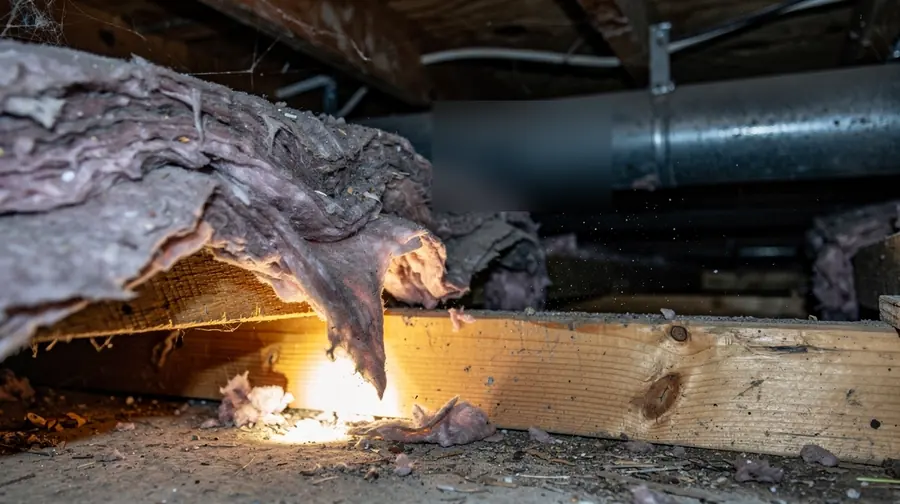
$4,000–$15,000A complete moisture seal using heavy-duty polyethylene liner on floors, walls, and supports. Eliminates ground moisture, prevents mold, and improves air quality. Most comprehensive solution.
Signs You Need This Service
- Musty odor in your home that worsens in summer
- Visible condensation on ductwork or pipes in the crawl space
- Humidity readings above 60% under the house
- Higher-than-expected heating and cooling bills
- Sagging or soft spots in your floors
What the Work Involves
A crew removes debris, addresses any standing water, and repairs damaged insulation or vapor barriers. They then seal all vents and openings, install a 12–20 mil reinforced polyethylene liner across the entire floor and up the walls to above grade, and tape every seam with waterproof sealing tape. Piers, columns, and pipes are individually wrapped. Most jobs finish in one to two days for an average-sized crawl space (1,000–1,500 sq ft).
Typical Cost Range
$4,000–$15,000 — across typical crawl space sizes, about $4,500–$11,000 for 1,000–1,500 sq ft. Basic liner-only jobs start around $1,200; full encapsulation with drainage and a dehumidifier can reach $22,000+. See the full cost guide for detailed pricing.
How Long It Lasts
A properly installed encapsulation liner lasts 15–25 years. The liner itself carries a manufacturer warranty (often 25 years), but seams, tape, and mechanical connections should be inspected every two to three years.
Vapor Barrier Installation
$1,200–$4,000A plastic sheeting layer on the crawl space floor that blocks ground moisture from evaporating into the space. Less comprehensive than full encapsulation but effective as a baseline fix.
Signs You Need This Service
- Damp or wet soil visible on the crawl space floor
- Condensation forming on floor joists or subflooring
- Mild musty smell, especially during humid months
- Minor surface mold on wood framing
What the Work Involves
The installer clears the crawl space floor of sharp debris and levels uneven ground. A 6–20 mil polyethylene sheet is laid across the entire floor, overlapping seams by 6–12 inches and secured with landscape stakes or adhesive. Higher-quality installs run the barrier a few inches up the foundation walls and seal the seams with contractor tape. The job typically takes half a day to one full day.
Typical Cost Range
$1,200–$4,000 — depending on thickness (6 mil vs. 20 mil), crawl space size, and whether seams are taped and sealed. Materials alone run $0.15–$0.50 per sq ft. See the full cost guide for detailed pricing.
How Long It Lasts
A basic 6 mil barrier lasts 5–10 years before degrading. Heavier 12–20 mil barriers last 15–20 years. Inspect annually for tears, pest damage, or displaced sections.
Crawl Space Waterproofing
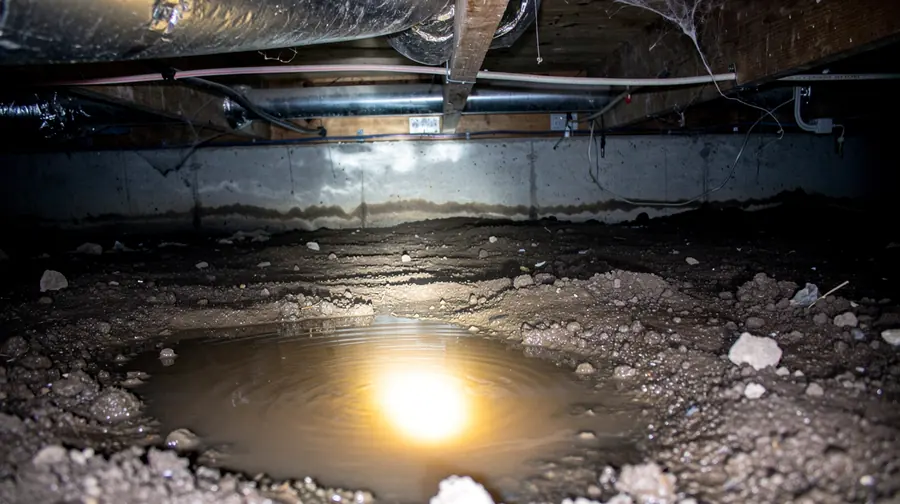
$3,000–$10,000Interior drainage systems, sump pumps, and wall coatings to manage water intrusion from rain and groundwater. Critical in flood-prone or high water-table areas.
Signs You Need This Service
- Standing water or puddles in the crawl space after rain
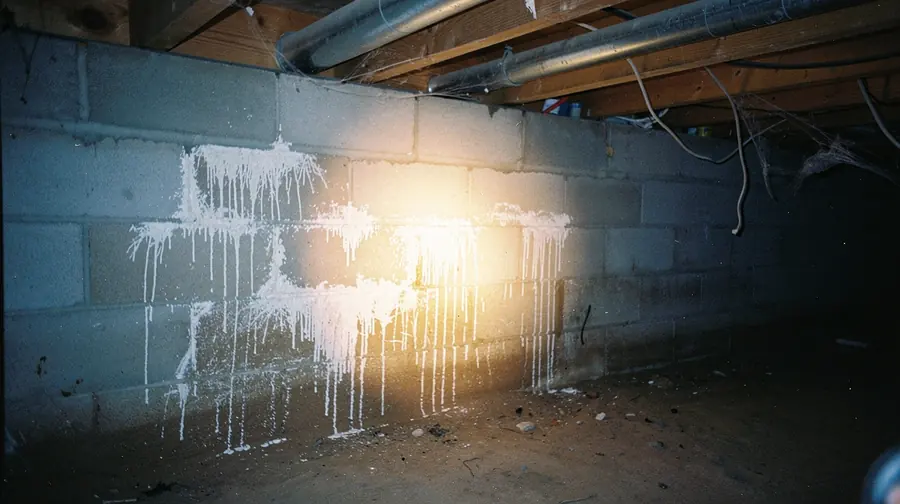
- Water stains or efflorescence (white mineral deposits) on foundation walls
- Wet or saturated soil even during dry weather (high water table)
- Water trickling through wall-floor joints during heavy rain
What the Work Involves
Interior waterproofing typically starts with installing a perimeter French drain along the base of the foundation walls. A sump pit is dug at the lowest point, and a sump pump is installed to discharge collected water outside the home. Wall surfaces may receive a waterproof coating or membrane. Exterior waterproofing — less common for crawl spaces — involves excavating around the foundation, applying a waterproof membrane to the outside of the walls, and installing a footer drain. Interior systems take one to three days; exterior work can take a week or more.
Typical Cost Range
$3,000–$10,000 — for interior waterproofing. Exterior waterproofing runs $7,000–$15,000+ because of the excavation required. See the full cost guide for detailed pricing.
How Long It Lasts
Interior drainage systems last 20–30 years with proper maintenance. Sump pumps need replacement every 7–10 years. Waterproof coatings last 10–15 years before reapplication.
Foundation Repair
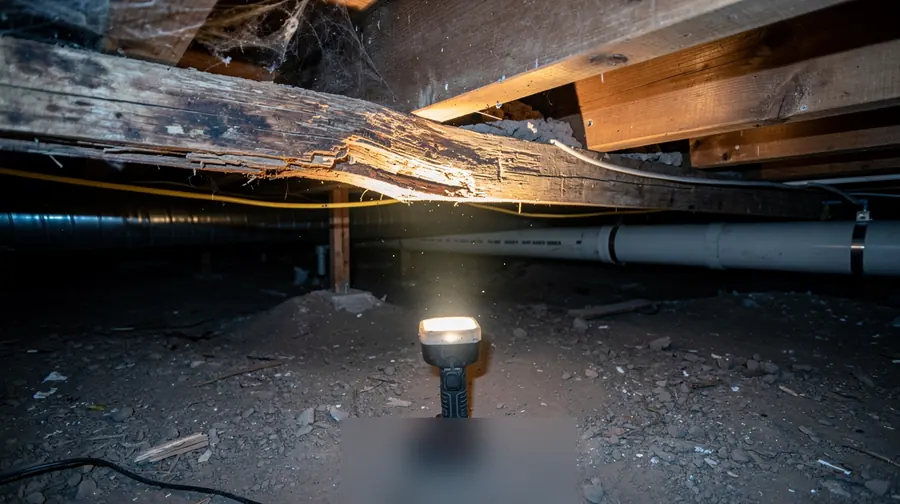
$2,000–$15,000+Cracks, settling, and structural movement in crawl space foundation walls and piers. Includes carbon fiber straps, wall anchors, helical piers, and crack injection.
Signs You Need This Service
- Visible cracks in foundation walls (especially horizontal or stair-step cracks)
- Doors and windows sticking or not closing properly
- Uneven or sloping floors
- Gaps between walls and ceiling or walls and floor
- Leaning or bowing foundation walls
What the Work Involves
The repair method depends on the type and severity of the damage. Hairline cracks are filled with epoxy or polyurethane injection. Bowing walls are stabilized with carbon fiber straps (bonded to the wall surface) or wall anchors (steel plates connected to anchors driven into the soil outside). Settling foundations are lifted and stabilized with helical piers or push piers driven to load-bearing soil or bedrock. Deteriorated block or pier foundations may need partial rebuilding. Simple crack repairs take a few hours; pier installation takes two to five days.
Typical Cost Range
$2,000–$15,000+ — depending on the repair type. Crack injection runs $300–$800 per crack. Carbon fiber straps cost $1,000–$2,000 per strap. Helical piers run $1,750–$3,000 per pier, with most homes needing 6–10 piers. See the full cost guide for detailed pricing.
How Long It Lasts
Properly installed piers and wall anchors are permanent solutions designed to last the life of the structure. Crack injections may need retreatment after 5–10 years if the underlying cause (soil movement, water pressure) is not addressed.
Interior Drainage Systems
$2,500–$9,000French drains and perimeter channels installed at the crawl space floor perimeter to collect and route water to a sump pump. The most reliable solution for active water intrusion.
Signs You Need This Service
- Water pooling along the base of crawl space walls
- Repeated standing water that returns after pumping
- Soil erosion channels visible on the crawl space floor
- Hydrostatic pressure pushing water through wall-floor joints
What the Work Involves
A trench is dug along the interior perimeter of the foundation, typically 6–8 inches wide and 8–12 inches deep. Perforated PVC pipe is laid in the trench on a bed of washed gravel, then covered with more gravel and filter fabric to prevent sediment clogging. The drain lines slope toward a sump pit where water is pumped out. Some systems use prefabricated channel systems instead of traditional pipe-and-gravel. Installation takes one to three days depending on the perimeter length.
Typical Cost Range
$2,500–$9,000 — for a full perimeter system including sump pump. Partial systems (one or two walls) run $1,500–$3,500. See the full cost guide for detailed pricing.
How Long It Lasts
French drain systems last 20–30 years when installed correctly. The gravel and filter fabric prevent clogging, but the sump pump motor will need replacement every 7–10 years. Annual inspection ensures drain lines remain clear.
Sump Pump Installation
$800–$3,000Electric pump installed in a pit at the lowest point of the crawl space. Automatically pumps out collected water. Most effective when paired with a drainage system.
Signs You Need This Service
- Water collecting in a low spot of the crawl space
- Existing sump pump running constantly or failing to keep up
- Burning smell or unusual noise from an aging pump
- Loss of power during storms causes flooding (no battery backup)
What the Work Involves
A sump pit (typically an 18–24 inch diameter, 22–36 inch deep basin) is excavated at the lowest point of the crawl space. The basin is lined with a perforated or solid sump liner. A submersible pump is placed inside, connected to a discharge line that carries water at least 10 feet from the foundation. A check valve prevents backflow. Most contractors recommend adding a battery backup pump that activates during power outages. Installation takes half a day to one full day.
Typical Cost Range
$800–$3,000 — for the pump, pit, discharge line, and installation. Battery backup systems add $500–$1,500. High-capacity or commercial-grade pumps run higher. See the full cost guide for detailed pricing.
How Long It Lasts
Sump pumps last 7–10 years on average. Battery backup batteries need replacement every 3–5 years. Test the pump quarterly by pouring water into the pit and confirming it activates and discharges properly.
Dehumidifier Installation
$1,000–$3,000Crawl Space-rated dehumidifiers (higher capacity than household units) maintain humidity below 60% - EPA advises keeping indoor humidity below 60 percent, ideally between 30 and 50 percent. Dehumidification is one of the options the model residential code (IRC R408.3) allows for an unvented crawl space, alongside exhaust ventilation, a conditioned air supply or a plenum.
Signs You Need This Service
- Humidity readings consistently above 60% in the crawl space
- Condensation on cold surfaces (ductwork, pipes, subflooring)
- Musty odor persists even after a vapor barrier is installed
- Visible mold returning after cleaning
What the Work Involves
A commercial-grade, crawl-space-rated dehumidifier (typically 70–130 pint capacity) is mounted or placed in the crawl space and connected to a drain line that routes condensate to a sump pump, floor drain, or outside the foundation. The unit is wired to a dedicated circuit or plugged into a GFCI outlet. A humidistat controls the target humidity level (typically set to 50–55%). Ducting may be added to improve air circulation in larger or L-shaped crawl spaces. Installation takes two to four hours.
Typical Cost Range
$1,000–$3,000 — including the unit and installation. Commercial crawl space dehumidifiers cost $800–$1,800 for the unit alone; installation adds $200–$1,200 for electrical and drain line work. See the full cost guide for detailed pricing.
How Long It Lasts
Crawl Space dehumidifiers last 8–12 years. Filters should be cleaned every three to six months. The drain line should be checked annually for clogs. Energy costs run $30–$60 per month depending on humidity levels and local electricity rates.
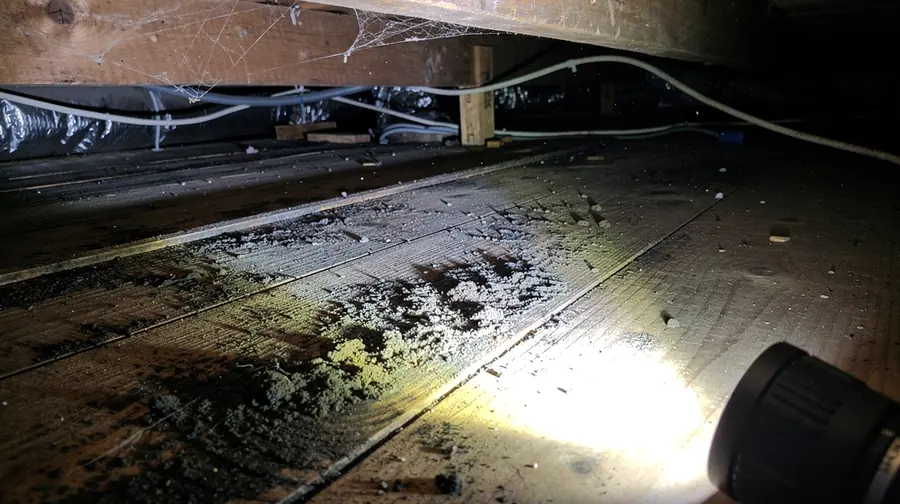
Mold Remediation
$1,500–$6,000Identification, treatment, and prevention of mold growth on joists, beams, and subfloor. Requires source moisture control — remediation without fixing the moisture problem will not last.
Signs You Need This Service
- Visible mold or mildew on wood framing, joists, or subflooring
- Strong musty smell from the crawl space that permeates the home
- Allergy symptoms or respiratory issues that worsen at home
- Dark discoloration on wood surfaces in the crawl space
What the Work Involves
A certified remediation crew first contains the work area with plastic sheeting and sets up negative air pressure to prevent spore spread. Affected surfaces are treated with antimicrobial agents, and heavily colonized materials (insulation, vapor barriers, severely damaged wood) are removed and disposed of. Wood framing is either sanded, media-blasted, or treated with an encapsulant depending on the severity. After treatment, surface sampling may be useful to determine if the area has been adequately cleaned or remediated. The entire process takes one to three days for a typical crawl space.
Typical Cost Range
$1,500–$6,000 — depending on the extent of the infestation and the crawl space size. Small areas (under 100 sq ft) run $1,500–$3,000; whole-crawl-space remediation runs $3,000–$6,000. Air quality testing adds $300–$600. See the full cost guide for detailed pricing.
How Long It Lasts
Mold remediation itself is a one-time treatment, but mold will return if the underlying moisture problem is not solved. After remediation, encapsulation or dehumidification is essential to prevent recurrence. Post-treatment inspections are recommended annually for the first three years.
Which Service Do I Need?
Crawl Space problems rarely arrive with a clear label. You notice a symptom — a smell, a wet floor, a crack — and need to figure out which service addresses it. Here is a practical guide based on what you are seeing.
Standing Water or Flooding After Rain
Your immediate need is water removal and prevention. Start with an interior drainage system paired with a sump pump. Once the active water is managed, add a vapor barrier to control ground moisture. If the water is entering through foundation wall cracks, address those with waterproofing at the same time.
Musty Smell but No Visible Water
This is almost always a humidity problem. Ground moisture is evaporating into the crawl space and creating conditions for mold growth — even if you do not see standing water. Encapsulation combined with a dehumidifier will seal the moisture source and keep humidity under control. If mold is already visible, add mold remediation before encapsulating.
Cracks in Foundation Walls or Uneven Floors
Structural issues take priority over everything else. Foundation repair should be your first call. After the structure is stabilized, add waterproofing to prevent the cracks from becoming water entry points. Do not encapsulate or install drainage until the structural engineer has cleared the foundation — moisture control on an unstable foundation is wasted money.
High Energy Bills or Cold Floors in Winter
Open crawl space vents allow outside air to flow directly under your home, making floors cold and forcing your HVAC system to work harder. Encapsulation seals the vents and creates a conditioned space that acts as insulation. In a DOE-funded field study of 12 homes in North Carolina, closed crawl space houses used 15–18% less energy for space heating and cooling than wall-vented crawl space houses.
Visible Mold on Joists or Subflooring
Mold remediation removes the existing growth, but the mold will return unless you eliminate the moisture source. Plan for remediation followed by either encapsulation or at minimum a vapor barrier plus dehumidifier. If mold is visible, testing before remediation is usually unnecessary; surface sampling afterward may be useful to determine if the area has been adequately cleaned.
Not sure what you are looking at? Use our contractor hiring checklist to prepare the right questions for your inspection, and find a contractor in your state to schedule one. Homeowners in high-humidity states like North Carolina, Virginia, and Georgia should prioritize encapsulation with a dehumidifier.
Common Service Combinations
Most crawl space problems require more than one service. Contractors frequently bundle these together because solving one problem without addressing the related issue means the fix will not hold. Here are the combinations you will see most often.
Encapsulation + Dehumidifier
Encapsulation seals out ground moisture, but the air inside the sealed space still needs humidity control. Without a dehumidifier, moisture from residual humidity, seasonal changes, or minor leaks has nowhere to go. This is the most common combination — most contractors include a dehumidifier in their encapsulation quotes.
Interior Drainage + Sump Pump + Vapor Barrier
If water is actively entering the crawl space, you need a system to collect it (drainage), remove it (sump pump), and block ground moisture from rising after the bulk water is handled (vapor barrier). This three-part system addresses both liquid water intrusion and ongoing moisture from the soil.
Foundation Repair + Waterproofing
Foundation cracks are both a structural issue and a water entry point. Repairing the cracks without waterproofing leaves the foundation vulnerable to future water pressure. Waterproofing without fixing structural damage means the cracks will widen and the waterproofing will eventually fail. Always address the structural problem first, then waterproof.
Mold Remediation + Encapsulation + Dehumidifier
Removing existing mold without controlling the moisture source guarantees the mold will return — often within months. The remediation removes the existing growth, encapsulation blocks the moisture source, and the dehumidifier maintains air humidity below 60 percent, the indoor limit EPA advises (ideally between 30 and 50 percent).
When getting quotes, ask whether the contractor recommends additional services and why. A good contractor will explain the relationship between services rather than simply upselling. For pricing details on any combination, check our cost guide.
Find a contractor near you
Enter a ZIP code, city, or state to see the crawl space contractors listed in your area. Every listing includes contact details so you can describe your specific job and request a quote directly.
Take the hiring checklist with you when you call.